Exterior painting built for sun, wind and cold nights.
With the foothills right behind town, a Boulder house takes more ultraviolet, more wind and more freeze-thaw than the same house on the plains. The work that decides how long it lasts happens before the first finish coat.
- Lap siding, shingle, board and batten, fiber cement, stucco and masonry
- Trim, fascia, soffits, doors, garage doors and railings
- Product picked per wall, with the hardest-hit sides spec’d up
- Written 5-year workmanship warranty
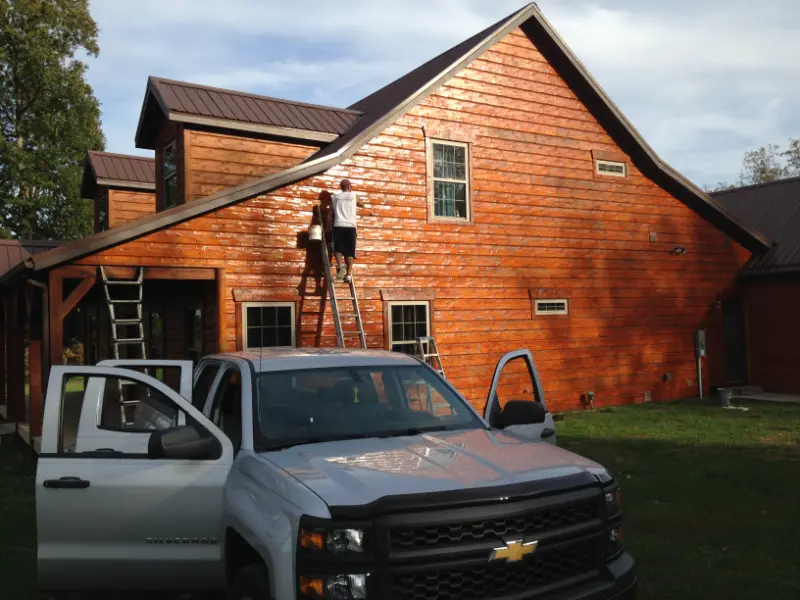
Direct answer: We paint house exteriors across Boulder County between mid-May and September, when overnight lows let paint cure. Each job starts with a wash, scraping to a sound edge, sanding the transitions, caulking open joints and priming bare wood, and the product and coat count for each wall are written into the estimate. South and west walls get the heaviest-duty product because they take the most sun. The work carries a written 5-year workmanship warranty.
What wears out paint in Boulder
Siding paint here fails for a short list of reasons, and you can usually tell which one by where the damage is. Wood siding has its own choices; see cedar siding staining. Cement board has its own rules too, covered on our fiber cement siding painting page.
- Sun. Boulder sits about 150 feet higher than downtown Denver and roughly 1,650 meters above sea level, and the U.S. EPA says UV rises by about 6% per 1,000 meters (about 2% per 1,000 feet). That load breaks down the resin in paint. You see it as fading, then as chalk, on the south and west walls first.
- Wind. Downslope winds off the foothills can gust hard enough to make national news. On a painting day they dry the surface of fresh paint too fast and blow dust into it.
- Water and frost. The Boulder weather station averages 138 nights a year at or below freezing. A gap in the caulk lets water behind the paint; it freezes, expands and lifts the film. That is why caulking is part of the structure of the job, not a cosmetic touch.
- Snow glare. Bright snow reflects sun onto the bottom of the walls and the undersides of eaves all winter, so those spots often go before the rest of the wall.
Reading the damage on your own house
| If you see | It usually means | The fix |
|---|---|---|
| White powder on your fingers after you touch a sunny wall | Chalking: the binder has broken down | A thorough wash, then repaint. New paint over chalk will not stick for long |
| Fading on only the south and west sides | Normal sun exposure for this elevation | Repaint, with a tougher product on those two sides |
| Paint coming off in sheets | Water getting behind it, or bare wood that was never primed | Stop the water first, then scrape, prime and paint |
| Peeling only along the lowest boards | Sprinkler spray or soil touching the siding | Re-aim the sprinkler heads. It costs almost nothing |
| Gray, fuzzy cedar | Sun has broken down the wood fibers at the surface | Clean, brighten and sand, then stain rather than paint |
| Bubbles on a sunny wall | Paint went on over damp wood or in direct afternoon heat | Scrape, let the wood dry, prime, repaint in the right conditions |
The weather window we hold to
NOAA’s climate normals for the Boulder weather station (1991 to 2020) put the median last spring freeze on May 6 and the median first fall freeze on October 5. Average lows only clear 50°F in June, July and August. Higher up, toward Nederland and Ward, the season is shorter at both ends.
Paint cures overnight as well as during the day, so the number we watch is the low, not the high. Some exterior lines are rated to 35°F; many standard ones still ask for 50°F. If the forecast low is below what the label allows, we move the day. Paint that goes on into a cold night can look fine for a season and then let go. The month-by-month numbers are on our Boulder painting data page, and the planning side is on season and altitude.
Older houses
If the house was built before 1978, scraping and sanding the old paint falls under the EPA lead rule, which changes how the prep is done and how long it takes. We ask the year on every estimate. See painting a pre-1978 home.
Other work we do in Boulder County
Historic homes
Landmark Alteration Certificate help, lead-safe practices and the hand preparation that old wood needs.
Read more →02Deck and fence staining
Decks, fences and timber cleaned, brightened and sealed before the sun at this elevation turns them gray.
Read more →03Color guide
Why colors read differently in Boulder light, which pigments fade first, and how to sample properly.
Read more →04Interior painting
Walls, ceilings, trim and doors, booked year-round because the work happens inside a heated house.
Read more →05Homes in wildfire areas
What paint and stain can and can’t do, the 6-inch strip at the base of the siding, and when the county code applies.
Read the guide →Exterior painting questions from Boulder homeowners
When can you paint the outside of a house in Boulder?
How much does exterior painting cost in Boulder?
Is sun damage really worse in Boulder?
What does wind do to fresh paint?
My home is in a historic district. What changes?
How long does an exterior take?
Get a written estimate
Your choice: we come out for a free walkthrough, or you send photos and skip the visit. Peeling, water damage or a landmark property gets a walkthrough first.
Every estimate names the surfaces, the preparation steps, the exact product line and sheen, the coat count, the schedule and the warranty.
Prefer to talk? 720-208-5645, seven days.