
Deck and fence staining, on the cycle altitude demands.
High-altitude sun takes wood apart faster than most homeowners expect. Sealing on schedule is maintenance. Waiting turns it into a lumber bill.
- Decks, fences, railings, pergolas, log and timber siding
- Cleaned and brightened so stain penetrates rather than sits
- Cedar, redwood, pine and pressure-treated lumber
- Written 5-year workmanship warranty
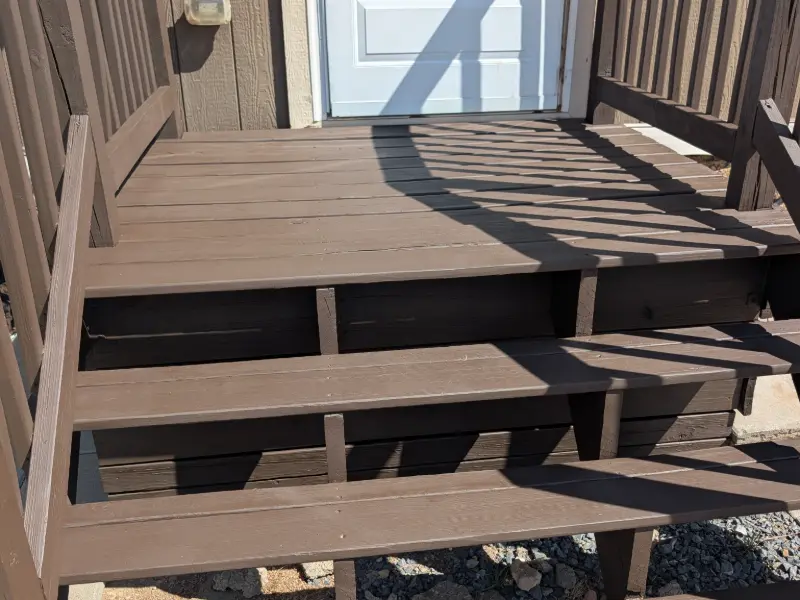
Direct answer: We stain decks, fences, railings, pergolas and log or timber siding across Boulder County. The wood is cleaned and brightened, sanded where the grain has lifted, and sealed with a penetrating stain rather than a paint film, because film coatings on walking surfaces peel and have to be stripped. Test your deck by pouring water on it: if it soaks in instead of beading, it is due.
The water test
You do not need a professional to tell you when your deck needs attention. Pour a cup of water on it. If it beads and sits, the seal is intact. If it soaks in and darkens the board, the wood is drinking every storm and snowmelt that lands on it, and the clock is running.
At Boulder's elevation, and especially on the west-facing decks around Chautauqua, Table Mesa and anything up a canyon, that moment arrives sooner than homeowners expect. A deck that held up for four years at sea level may need attention in two here.
Why stain and not paint
Paint forms a film on top of the wood. On a horizontal surface that takes standing water, snow load and foot traffic, that film eventually fails, and when it does it peels in sheets and has to be stripped entirely. Stain penetrates into the wood instead. When it wears, it wears away rather than lifting, which means the next maintenance cycle is a clean and recoat rather than a removal project.
This is why we will generally talk you out of painting a deck surface even when you ask for it. The same trade-off applies to wood siding, and our guide to how long stain lasts on siding has the federal numbers.
Choosing a transparency
| Type | Shows grain | Lasts | Best for |
|---|---|---|---|
| Transparent | Fully | Shortest cycle | New or beautiful wood you want to show off |
| Semi-transparent | Mostly | Middle | The usual pick for Boulder decks |
| Semi-solid | Grain texture, little figure | Longer | Weathered boards with blotchy color |
| Solid | No | Longest appearance | Fences and weathered wood. Hardest to reverse later |
Log and heavy timber
Above town toward Nederland, and on the timber-framed homes along the foothills, the work changes character. Log surfaces need penetrating stain plus attention to checking, which are the cracks that open as logs dry, and to chinking where it exists. Those cracks collect water, and a stain job that ignores them is cosmetic only. We address them as part of the scope.
Deck and fence staining questions from Boulder homeowners
How often does a Boulder deck need restaining?
Why did my last stain peel off in sheets?
Should I paint my deck instead?
Do you work on log homes?
How soon can new deck boards be stained?
What about boards that are already damaged?
Get a written estimate
Your choice: we come out for a free walkthrough, or you send photos and skip the visit. Peeling, water damage or a landmark property gets a walkthrough first.
Every estimate names the surfaces, the preparation steps, the exact product line and sheen, the coat count, the schedule and the warranty.
Prefer to talk? 720-208-5645, seven days.