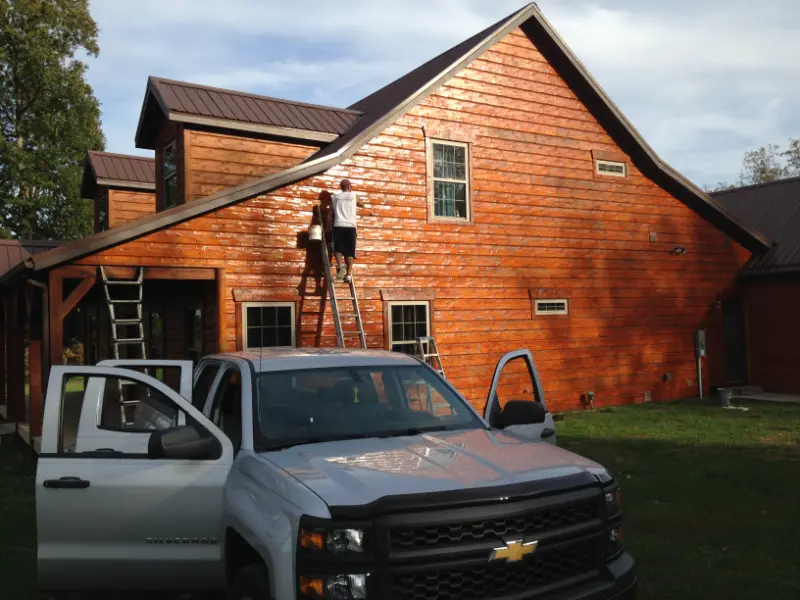
Cedar siding staining in Boulder County.
Wood siding is a big part of why Boulder houses look the way they do, and the sun up here is hard on it. Here is how to choose between stain and paint, how long each lasts, what it costs and when it can be done.
- Semitransparent stain on rough-sawn cedar: 4 to 8 years (USDA)
- Three-coat paint on rough-sawn cedar: 15 to 20 years (USDA)
- Denver-area price for wood siding: $1 to $3.05 per sq ft (Angi)
- Boulder season: about May 6 to October 5 between median freezes (NOAA)
By Boulder CO Painters · Updated
Direct answer: On cedar siding in Boulder, semitransparent stain keeps the grain and wears away rather than peeling. The USDA Wood Handbook gives it 4 to 8 years on rough-sawn cedar and about half that on smooth. Paint or solid stain lasts longer but hides the wood. Angi’s Denver-area figure for wood siding is $1 to $3.05 per square foot. Stain between mid-May and September.
Should you stain or paint cedar siding?
The honest answer depends on what you want to see and how often you want to see a crew. Stain soaks in; paint sits on top. The USDA Forest Products Laboratory’s Wood Handbook is the most-cited federal reference on how long each lasts, and its numbers for cedar and redwood siding are below. They are for an average location in the contiguous U.S., and the handbook says expected life depends on climate and exposure.
| Cedar surface | Semitransparent stain | Solid-color stain | Paint (primer + 2 coats) |
|---|---|---|---|
| Rough-sawn (saw-textured) | 4–8 | 10–15 | 15–20 |
| Smooth, vertical grain | 2–4 | 8–12 | 10–15 |
| Smooth, flat grain | 2–4 | 6–10 | 8–12 |
Three things stand out. Rough-sawn cedar holds roughly twice as much finish as smooth, so everything lasts longer on it. A two-coat paint system (primer and one topcoat) lasts about half as long as primer and two topcoats, per the handbook’s footnote. And stain’s shorter life comes with an easier recoat: a penetrating stain wears away instead of peeling, so the next coat is mostly cleaning and restaining, not scraping.
When we recommend stain
- You like the look of the wood and want the grain to show.
- The siding is rough-sawn, or weathered enough that a film would struggle to stick.
- You would rather do a lighter maintenance coat every several years than a bigger repaint less often.
When paint or solid stain makes more sense
- The siding is smooth, patched or a mix of old and new boards that will never match under a translucent stain.
- You want the longest time between coats.
- The house has already been painted. Going back to a semitransparent stain means removing the film, which is a much bigger job.
Our guide to how long stain and paint last on wood siding goes through the whole table and has a calculator for when your walls are due.
What makes Boulder hard on wood siding?
- Sun at altitude. The EPA says UV intensity rises about 6% per kilometer of elevation. NOAA lists the Boulder weather station at 1,671.5 meters, which works out to roughly 10% more UV than at sea level (our arithmetic). UV breaks down both the finish and the wood surface under it, so south and west walls fade and gray first.
- Tannins. Western redcedar and redwood contain water-soluble extractives that can bleed through paint as brown stains. The handbook advises stain-blocking primers under paint on those species.
- A short season. The median freeze-free stretch at the Boulder station runs from May 6 to October 5, and every coat has to fit inside it.
- Weathered surfaces. Gray, fuzzy cedar has loose fibers that do not hold any finish well. They have to come off before staining.
What will staining your siding cost?
Enter the wall area or the wall length and height. The range uses Angi’s Denver-area rate for painting wood siding, the closest published figure for the Front Range.
How do we stain cedar siding?
- Look first. We check each wall for gray fibers, mildew, peeling film, loose boards and soft wood, and test whether water still beads.
- Clean and brighten. A wood cleaner removes dirt, mildew and the gray surface; a brightener evens the color. Then the wood dries fully.
- Sand where it is fuzzy. Loose, sun-damaged fibers come off so the stain bonds to sound wood.
- Repair. Split or rotten boards are replaced, and fasteners reset.
- Stain by brush, a few boards at a time. The handbook recommends brushing oil-based semitransparent stains to work them into the wood, and staining two or three boards along their full length at a time to prevent lap marks. On rough-sawn or weathered cedar, a second coat can go on while the first is still wet.
- Walk it with you. Every wall, before we leave. The work carries our 5-year workmanship warranty.
When can cedar be stained in Boulder?
The handbook’s guideline for latex finishes is at least 50°F, staying there for 24 hours, and it warns against late-afternoon work when heavy dew is expected. Product labels set their own limits. Here is the Boulder station through the season:
| Month | Days with a high of 50°F+ | Average high | Average low |
|---|---|---|---|
| April | 26 | 62.8°F | 34.5°F |
| May | 29.8 | 71.3°F | 42.7°F |
| June | 30 | 82.5°F | 51.1°F |
| July | 31 | 88°F | 57°F |
| August | 31 | 86°F | 55.5°F |
| September | 29.7 | 78.8°F | 48.1°F |
| October | 28.3 | 65.9°F | 37.2°F |
Average lows only clear 50°F in June, July and August, so May, September and early October jobs are planned day by day around the overnight forecast. Our page on the painting season and altitude explains how we plan around it, especially for houses up the canyons.
Cedar siding questions
Should cedar siding be stained or painted in Boulder?
How much does it cost to stain wood siding?
How often does cedar siding need restaining?
When is the staining season in Boulder?
Can gray, weathered cedar be stained?
Sources
Every number on this page comes from the source listed. Checked October 22, 2026.
- Wood Handbook, chapter 16: finishing of wood, Tables 16-2 and 16-3 (FPL-GTR-282), USDA Forest Service, Forest Products Laboratory, 2021.
- How much does it cost to paint a house exterior in Denver, CO?, Angi, updated November 13, 2025 (Denver-area prices by siding type).
- U.S. Climate Normals 1991–2020, Boulder (USC00050848), monthly, NOAA National Centers for Environmental Information.
- U.S. Climate Normals 1991–2020, Boulder, freeze dates and elevation, NOAA National Centers for Environmental Information.
- Learn about the UV Index, U.S. Environmental Protection Agency.
Get your siding looked at
Your choice: we come out for a free walkthrough, or you send photos and skip the visit. Peeling, water damage or a landmark property gets a walkthrough first.
Every estimate names the surfaces, the preparation steps, the exact product line and sheen, the coat count, the schedule and the warranty.
Prefer to talk? 720-208-5645, seven days.